
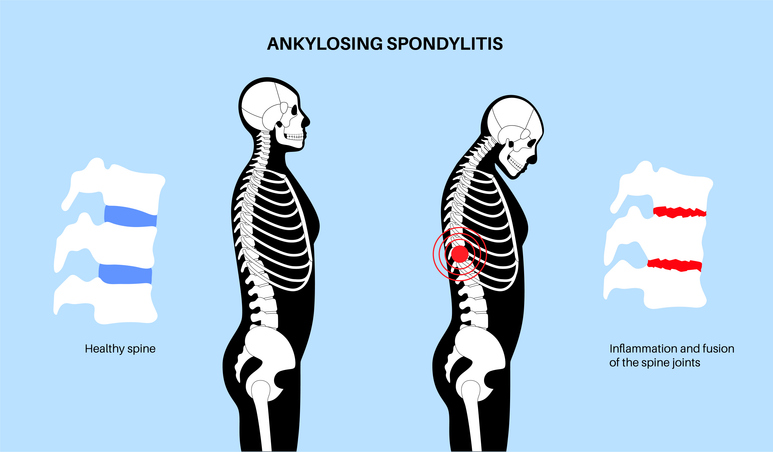
Ankylosing spondylitis (AS) is a chronic autoimmune inflammatory arthritis that primarily targets the axial skeleton — the spine and sacroiliac joints — and, if unchecked, can progress to fusion of spinal vertebrae through a process of pathological new bone formation. It is far more than back pain. It is a systemic inflammatory disease with implications for the gut, the eyes, the heart, and the lungs — and it carries a specific genetic signature that profoundly shapes our functional medicine investigation.
What Is Happening in AS?
AS is classified as a spondyloarthropathy, a family of conditions characterized by enthesitis — inflammation specifically at the entheses, the sites where tendons and ligaments attach to bone. In AS, this inflammation concentrates at the sacroiliac joints and intervertebral attachments. Over time, the body’s attempt to heal these inflammatory sites leads to the deposition of new bone (syndesmophytes), which progressively bridges and fuses adjacent vertebrae — a process called ankylosis.
The immunological drivers are distinct from RA: AS is a predominantly IL-17 and IL-23 driven disease, with Th17 cells playing a central role. TNF-alpha is also significantly involved, which is why anti-TNF biologics were the first effective pharmaceutical intervention developed. Notably, AS does not involve the classic autoantibodies (RF, anti-CCP) seen in RA — which is why it falls into the seronegative spondyloarthropathy category.
Why Does AS Develop? The Root Factors We Investigate
HLA-B27 genetic susceptibility. Approximately 90% of AS patients carry the HLA-B27 allele — the strongest genetic association of any autoimmune disease. HLA-B27 appears to promote misfolding of proteins within immune cells, generating endoplasmic reticulum stress and IL-23 production that drives the Th17 inflammatory cascade. HLA-B27 is not destiny — many carriers never develop AS — but it is an essential part of the risk architecture.
The gut-spine axis: a defining feature of AS. This is one of the most compelling and disease-specific relationships in rheumatology. Approximately 50–60% of AS patients have subclinical gut inflammation detectable on colonoscopy, and 5–10% have frank inflammatory bowel disease (Crohn’s or ulcerative colitis). The current leading hypothesis is that gut microbial dysbiosis — particularly in HLA-B27 carriers — generates intestinal immune activation that drives systemic Th17 responses targeting the axial skeleton. Animal studies have shown dramatically: HLA-B27 transgenic rats raised in a germ-free environment do not develop spondylitis. The microbiome is not incidental — it appears causal.
Klebsiella and molecular mimicry. Research has long identified elevated antibodies to Klebsiella pneumoniae in AS patients, with structural homology between Klebsiella proteins and the HLA-B27 molecule and collagen. This molecular mimicry hypothesis suggests that Klebsiella gut colonization may be a specific trigger in genetically susceptible individuals — a relationship we evaluate and address.
Gut permeability. AS patients show elevated fecal calprotectin and other markers of intestinal inflammation, even without IBD diagnosis. Restoring gut integrity is a central pillar of our AS approach.
How We Approach AS in Functional Medicine
Our evaluation includes HLA-B27 status (if not already known), comprehensive gut microbiome and permeability assessment, inflammatory and immune markers, and a full assessment of co-existing spondyloarthropathy manifestations (uveitis, psoriasis, IBD).
Functionally, we implement a targeted gut-healing protocol — often including a low-starch dietary approach (starch feeds Klebsiella selectively), targeted probiotics to shift microbial composition, and intestinal permeability support. IL-17 pathway inflammation responds to omega-3 optimization, vitamin D correction, and curcumin. Sleep and HPA axis management reduce the systemic inflammatory burden driving flares.
Ankylosing Spondylitis Has Deeper Roots Than Your Spine
If you’ve been diagnosed with AS and want to understand the gut, immune, and genetic drivers behind your condition — and explore what can be done to address them — I’d love to be part of your care team.
