
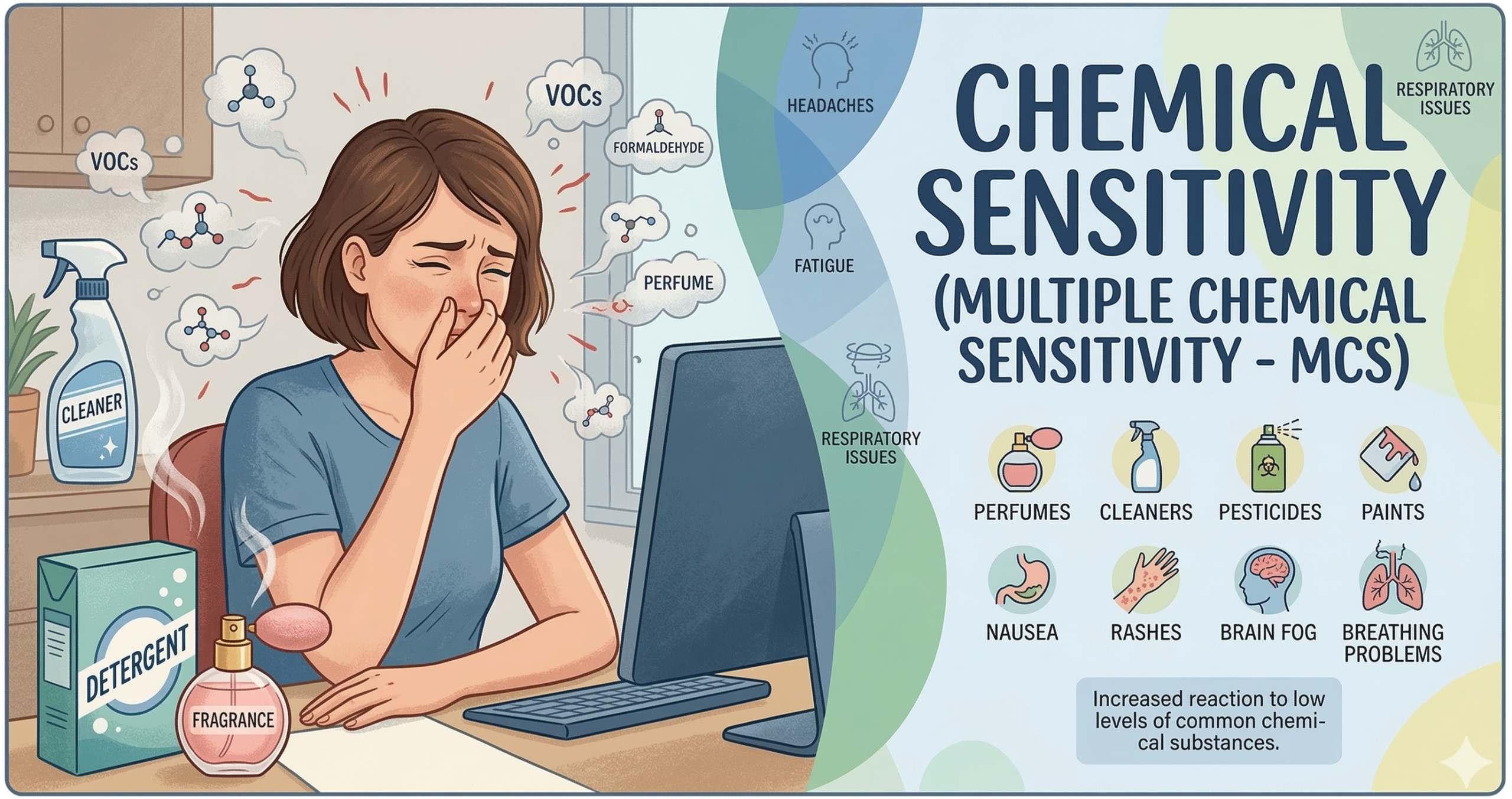
The smell of a coworker’s perfume gives you a headache within minutes. Walking down the laundry aisle makes you dizzy. A freshly painted room, new carpet or car exhaust leaves you foggy, nauseated or exhausted for hours. People around you seem fine, and some may even suggest it’s “all in your head.”
It isn’t. Multiple chemical sensitivity (MCS) is real, it can be debilitating, and it often improves when the underlying causes are found and addressed in the right order.
What Is Multiple Chemical Sensitivity?
MCS is a condition in which a person develops symptoms in multiple body systems in response to low levels of everyday chemicals that most people tolerate without problems. Symptoms can range from mild to life-limiting, affecting work, housing, relationships and social life.
Common Triggers
- Perfume, cologne, scented lotions and hair products
- Air fresheners, scented candles and laundry products
- Household cleaners, bleach and ammonia
- Pesticides and herbicides
- Paint, solvents, varnish and new building materials (off-gassing VOCs)
- New carpet, furniture and mattresses
- Vehicle exhaust and gasoline
- Tobacco smoke
- Dry-cleaning chemicals
- Some foods, food additives and medications
Common Symptoms
- Headaches and migraines
- Brain fog, memory and concentration problems
- Fatigue and weakness
- Dizziness and nausea
- Nasal congestion, sore throat and breathing difficulties
- Muscle and joint aches
- Digestive upset, constipation or diarrhea
- Skin rashes or flushing
- Anxiety, irritability and mood changes
What Drives Chemical Sensitivity?
There is no single cause. In my practice, MCS usually reflects a body that has been pushed past its limits. Key drivers include:
1. A “toxic terrain” and overwhelmed detox pathways
The liver processes chemicals in two phases. When these pathways are overloaded, or when genetic variants (such as in CYP450, GST or COMT genes) slow them down, chemicals build up and trigger symptoms.
2. An initial sensitizing event
Many people can point to a starting point: a chemical spill, pesticide exposure, mold exposure, a renovation, a viral illness or a period of intense stress.
3. Mold and hidden infections
Mold illness is one of the most common underlying contributors I find. Lyme disease, parasites and other chronic infections can also add to the load.
4. Limbic system sensitization
The brain’s alarm center can become hypersensitive, reacting to chemical signals as if they were a threat. This is a real, physical nervous system change.
5. Mast cell activation
Overactive mast cells release histamine and other chemicals that cause flushing, hives, congestion and brain fog.
6. Oxidative stress and low antioxidant reserves
When glutathione and other antioxidants run low, cells become more vulnerable to chemical damage.
When the body is fighting many stressors at once, it stays in a defensive state. That is why addressing the stressors in the right order matters.
Why MCS Is So Often Dismissed
Standard labs are usually normal, and there is no single diagnostic test. This leads some clinicians to attribute symptoms to anxiety. But growing research, including studies of people exposed to water-damaged buildings, supports physical mechanisms, especially detox impairment and nervous system sensitization.
How I Investigate at Good News Naturopathic Clinic
I choose each test from the specialty lab best suited to your situation, so the exact panels vary from patient to patient.
- Detailed exposure and trigger history
- Genetic detox profiling — CYP450, GST and COMT variants
- Organic acids testing and liver function markers
- Urine mycotoxin testing to look for mold exposure
- Environmental toxin testing for chemicals such as pesticides, plastics and solvents
- Mast cell screening — tryptase, histamine and related markers
- Oxidative stress and antioxidant status — glutathione and related markers
- Infection screening when history suggests it
A Step-by-Step Recovery Plan
- Reduce your daily chemical load. Go fragrance-free at home, use simple cleaners such as vinegar and baking soda, ventilate, and use a HEPA and carbon air purifier.
- Create a “safe space.” Make your bedroom as clean and chemical-free as possible so your body can recover at night.
- Address mold and infections if testing finds them.
- Support detox pathways — glutathione, NAC, sulforaphane, milk thistle and B vitamins, as tolerated and introduced slowly.
- Calm mast cells when needed, with a lower-histamine diet and targeted support.
- Retrain the nervous system. Limbic retraining programs such as DNRS or the Gupta Programme can be powerful additions.
- Rebuild tolerance gradually. Many patients find their world gets bigger over time.
Ready to Reclaim Your Life?
Chemical sensitivity doesn’t have to control your life. With the right investigation and support, many patients significantly expand their tolerance. I see patients in person in Norwalk, CT, serving Fairfield County and the NYC metro area, and by telehealth for Connecticut residents.
Book your consultation with Dr. Jamie Ahn today.
Related Reading
- Mold Illness: Why Your House May Be Making You Sick
- Can Mold Affect Your Brain?
- Mast Cell Activation
- Detoxification Issues
Frequently Asked Questions
Is multiple chemical sensitivity a real condition?
Yes. While there is no single diagnostic test, research supports physical mechanisms including detox impairment, mast cell activation and nervous system sensitization.
Can chemical sensitivity be caused by mold?
Mold exposure is one of the most common contributors I find. Studies of people in water-damaged buildings show high rates of new chemical sensitivity.
Will I always be this sensitive?
Many people improve substantially when underlying causes are addressed and the nervous system is retrained. Progress is often gradual.
Can I still take supplements if I’m very sensitive?
Yes, but they should be introduced one at a time, at low doses, and chosen carefully to avoid fillers and fragrances.
References
- Hyvönen S, et al. High prevalence of neurological sequelae and multiple chemical sensitivity among occupants of a Finnish police station damaged by dampness microbiota. Archives of Environmental & Occupational Health, 2021;76(3):145–151. https://pubmed.ncbi.nlm.nih.gov/32544007/
- National Institute of Environmental Health Sciences. Endocrine Disruptors. https://www.niehs.nih.gov/health/topics/agents/endocrine
This article is for educational purposes only and is not a substitute for individual medical advice.
